by Jule Schultz, Waterkeeper with Spokane Riverkeeper
Recently our community science program has had some big wins. In 2025 the Spokane River was listed as polluted based on our data providing a policy to support the restoration work local organizations, including ours, are doing in the basin.
And although it’s harder to quantify, we’ve reached hundreds of volunteers and partners with our study. In addition to the valuable data they provide, these trained volunteers come out of our study knowing more about our river, and the pollution that plagues it than they did before the study. Community science programs are the perfect educational tool to learn about our environment and apply STEM principles to real world problems. Many participants value the deeper understanding of how science can be used to protect and restore a river, and how they are part of this solution!
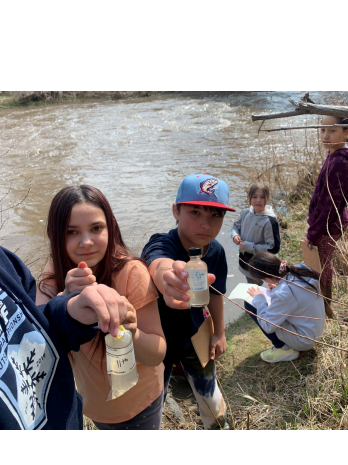
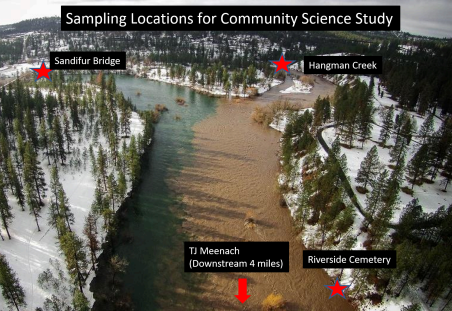
The basic idea behind our study is to quantify the contribution of sediment pollution from Hangman (Latah) Creek to pollution in the Spokane River. Volunteer scientists take readings and samples in the Spokane River, above and below the mouth of the creek, taking photos, and uploading their findings.
Spokane Riverkeeper analyzes the samples and enters the data into the state database, which allows for the data to be used by government regulators and policy makers.
This study checks boxes for many learning styles. Learning about this process is an educational tool in and of itself, while in-field sampling provides a place based educational opportunity. Traditional, in classroom (or in office) education comes from the training, which summarizes the pollution problem and why it exists, and gives examples of solutions that are being implemented throughout the watershed.
In fact, a few partner schools have built lessons around this study, adding parameters and tests that complement what we are seeing in the field. These lessons are then complemented by creating posters, presentations, or other communication materials that the Spokane Riverkeeper can use for outreach!